


TEXASLAWMAN
Lone Star Boars Owner
LSB TURKEY BUZZARD PRESERVATION SOCIETY
SUS VENATOR CLUB
LoneStarBoars Supporter
An in-depth look at what's changed with the new Storm S6R V2 click here to buy, what matters in the field, and whether the new STORM S6R V2 is worth upgrading to.
RIX Optics recently introduced its second-generation STORM lineup, including the new STORM S6R V2, and you'll find some substantial changes over the original STORM S6R.
We're talking about improved thermal sensitivity, a significantly upgraded display, a longer-range laser rangefinder, integrated ballistic calculations, and a redesigned mounting system. RIX has been the leader in high humidity performance for the last couple of years, they have retained that spot with these new V2 models.
The question is simple: How much of an improvement is it, and should existing STORM owners consider upgrading? If you do not currently have a Storm the older model S6R has been discontinued but still on sale click here to buy for $2,599. My opinion is the new V2 is worth the $400 difference.
Let's take a closer look.
Specifications are based on RIX's published generation comparisons and S6R V2 product information.

RIX OPTICS
Looking at those numbers, one detail deserves attention: both generations retain the same 640 × 512 sensor resolution. But the V2 has the the upgraded thermal detector.
The original STORM S6R featured thermal sensitivity rated below 20 mK. The new S6R V2 improves that specification to below 15 mK, accompanied by updated image-processing algorithms and RIX's RET technology.
For those unfamiliar with NETD (Noise Equivalent Temperature Difference), the number indicates how effectively a thermal detector can distinguish small differences in temperature. Generally speaking, lower is better.
Why should hunters care?
On a cool, dry night, even an average thermal scope can produce an impressive image. Introduce high humidity, warm ground temperatures, or low thermal contrast, and things become considerably more challenging.
The improved thermal sensitivity of the S6R V2 is intended to help distinguish subtle temperature differences when those conditions become difficult.
Combined with updated image processing, the new detector provides better definition and separation between animals and their surroundings.
Of course, NETD alone doesn't determine image quality. Lens quality, processing, display characteristics, and environmental conditions all contribute to the final image.
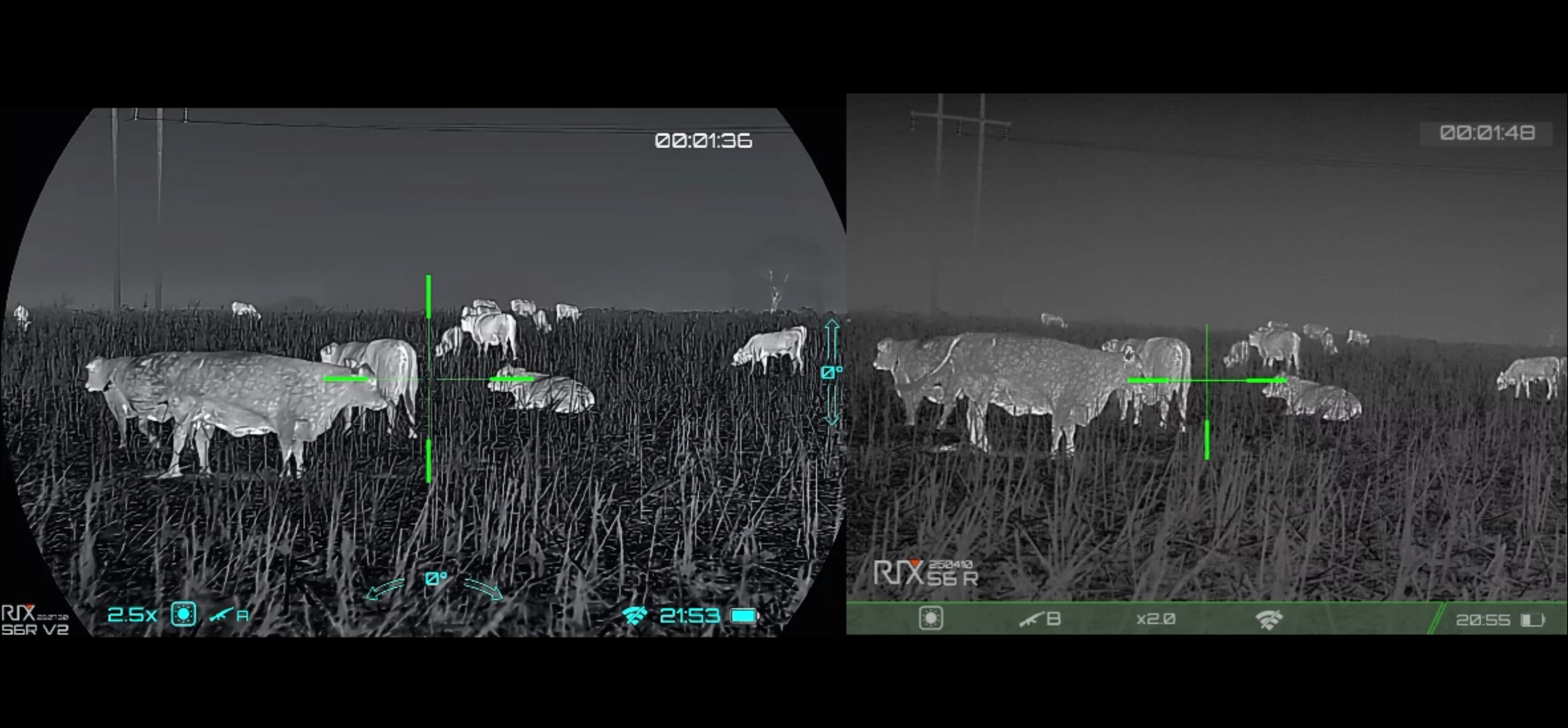
A side-by-side comparison of both generations on a humid Texas night click this link to see Lone Star Boars Youtube side by side video.
The new S6RV2 display receives a substantial upgrade.
The original S6R used a 0.39-inch AMOLED display with a resolution of 1024 × 768.
The V2 features a larger 0.49-inch AMOLED display with a resolution of 1920 × 1080.
That's a significant increase in display resolution. Unfortunately in the side-by-side video comparison above, the image only shows the improved sensor not the added screen improvement. Screen improvement does not show unless you are actually looking through the unit and using the screen.
RIX has also redesigned the viewing system, introducing a sub-round viewing design, a larger exit pupil, and increased eye relief.
Eye relief increases from 48mm to 52mm.
These improvements are intended to provide a more comfortable viewing experience while making better use of the image generated by the thermal detector.
It's important to understand that a higher-resolution display doesn't magically increase the resolution of the thermal sensor. However, it can improve how the processed image, menus, and reticles are presented to the shooter.
For hunters who spend extended periods scanning fields or watching animals through their optics, viewing comfort deserves considerably more attention than it typically receives.
The Upgraded integrated laser rangefinder is another major improvement.
The original S6R offered a maximum advertised ranging distance of 1,312 yards. The new V2 increases that figure to an impressive 2,187 yards.
That's an additional 875 yards of advertised ranging capability.
RIX has also incorporated improved rangefinder sensitivity and algorithms intended to enhance performance in rain and fog.
However, there's an important distinction between maximum advertised ranging distance and the distance at which a rangefinder will consistently measure an animal.
Reflectivity, atmospheric conditions, target size, and other environmental factors can substantially influence actual performance. I was able to successfully range a cow at 1864 yards.
A 2,187-yard specification certainly doesn't mean hunters should expect to range individual hogs consistently at that distance.
Nevertheless, the improved rangefinder is a welcome development, especially when combined with the V2's new ballistic calculation capabilities.
More precise zeroing and reticle improvements. Sometimes it's the smaller changes that deserve attention.
According to RIX, the original STORM featured zero adjustments of approximately 0.65 MOA, equivalent to around 0.68 inches at 100 yards.
The S6R V2 improves that specification to approximately 0.43 MOA per adjustment, or 0.45 inches at 100 yards.
The new generation also features a finer reticle intended to obscure less of the thermal image.
These changes provide more precise adjustment when establishing a zero. The V2 also offers nine reticle styles and five reticle colors, with additional customization available through the RIX+ application.
Redesigned mounting system and improved controls. RIX has made several physical changes to the V2 that may be easy to overlook.
The laser rangefinder has been relocated from the right side of the optic to the left. The redesigned quick-detach mount is also raised and extended, with its release lever positioned on the left.
These modifications are intended to improve mounting flexibility and provide additional clearance around bolt handles.
The new generation also introduces an ergonomic four-way control layout, a threaded eyecup, and changes to the battery-cap locking position.
Compact size, new 18650 batteries. Despite the additional capabilities, RIX has retained the compact design that helped distinguish the original STORM lineup.
The V2 measures approximately 6.42 inches long and weighs around 1.16 pounds.
It uses replaceable protected top (button top)18650 batteries, the S6R and older S6 used flat top unprotected 18650 batteries flat top batteries are generally 65mm in length while button tops are generally 70mm in lenth.
Additional features include Wi-Fi connectivity, compatibility with the RIX+ application, photo and video recording with a built-in microphone, six thermal color palettes, and an IP67 water-resistance rating.
The application also supports wireless firmware updates, live image streaming, and additional reticle and rangefinder customization.
That brings us to the question existing STORM owners are probably asking.
Is the V2 sufficiently improved to justify replacing the original? That really depends on you and your situation. The original S6R still offers a 640 × 512 thermal sensor, a 35mm objective lens, and an integrated laser rangefinder. If you're satisfied with its image quality and existing capabilities, the V2 isn't automatically an essential purchase. For most people I would say keep your old storm.
For hunters using bolt-action rifles the redesigned mount will be worth it.
However, there's an equally important argument for keeping the original. But if buying new I would get the new V2
RIX Optics recently introduced its second-generation STORM lineup, including the new STORM S6R V2, and you'll find some substantial changes over the original STORM S6R.
We're talking about improved thermal sensitivity, a significantly upgraded display, a longer-range laser rangefinder, integrated ballistic calculations, and a redesigned mounting system. RIX has been the leader in high humidity performance for the last couple of years, they have retained that spot with these new V2 models.
The question is simple: How much of an improvement is it, and should existing STORM owners consider upgrading? If you do not currently have a Storm the older model S6R has been discontinued but still on sale click here to buy for $2,599. My opinion is the new V2 is worth the $400 difference.
Let's take a closer look.
1. Original STORM S6R vs. S6R V2: What's Changed?
Before digging into individual features, here's a comparison of some of the most significant changes.| Feature | Original S6R | New S6R V2 |
|---|---|---|
| Thermal resolution | 640 × 512 | 640 × 512 |
| Thermal sensitivity | NETD <20 mK | NETD <15 mK |
| Objective lens | 35mm | 35mm F1.0 |
| Base magnification | 2× | 2.5× |
| AMOLED display | 1024 × 768 | 1920 × 1080 |
| Display size | 0.39" | 0.49" |
| Laser rangefinder | 1,312 yards | 2,187 yards |
| Eye relief | 48mm | 52mm |
| Ballistic calculator | Yes | Yes |
| LRF positioning | Right side | Left side |
RIX OPTICS
Looking at those numbers, one detail deserves attention: both generations retain the same 640 × 512 sensor resolution. But the V2 has the the upgraded thermal detector.
The original STORM S6R featured thermal sensitivity rated below 20 mK. The new S6R V2 improves that specification to below 15 mK, accompanied by updated image-processing algorithms and RIX's RET technology.
For those unfamiliar with NETD (Noise Equivalent Temperature Difference), the number indicates how effectively a thermal detector can distinguish small differences in temperature. Generally speaking, lower is better.
Why should hunters care?
On a cool, dry night, even an average thermal scope can produce an impressive image. Introduce high humidity, warm ground temperatures, or low thermal contrast, and things become considerably more challenging.
The improved thermal sensitivity of the S6R V2 is intended to help distinguish subtle temperature differences when those conditions become difficult.
Combined with updated image processing, the new detector provides better definition and separation between animals and their surroundings.
Of course, NETD alone doesn't determine image quality. Lens quality, processing, display characteristics, and environmental conditions all contribute to the final image.
A side-by-side comparison of both generations on a humid Texas night click this link to see Lone Star Boars Youtube side by side video.
The new S6RV2 display receives a substantial upgrade.
The original S6R used a 0.39-inch AMOLED display with a resolution of 1024 × 768.
The V2 features a larger 0.49-inch AMOLED display with a resolution of 1920 × 1080.
That's a significant increase in display resolution. Unfortunately in the side-by-side video comparison above, the image only shows the improved sensor not the added screen improvement. Screen improvement does not show unless you are actually looking through the unit and using the screen.
RIX has also redesigned the viewing system, introducing a sub-round viewing design, a larger exit pupil, and increased eye relief.
Eye relief increases from 48mm to 52mm.
These improvements are intended to provide a more comfortable viewing experience while making better use of the image generated by the thermal detector.
It's important to understand that a higher-resolution display doesn't magically increase the resolution of the thermal sensor. However, it can improve how the processed image, menus, and reticles are presented to the shooter.
For hunters who spend extended periods scanning fields or watching animals through their optics, viewing comfort deserves considerably more attention than it typically receives.
The Upgraded integrated laser rangefinder is another major improvement.
The original S6R offered a maximum advertised ranging distance of 1,312 yards. The new V2 increases that figure to an impressive 2,187 yards.
That's an additional 875 yards of advertised ranging capability.
RIX has also incorporated improved rangefinder sensitivity and algorithms intended to enhance performance in rain and fog.
However, there's an important distinction between maximum advertised ranging distance and the distance at which a rangefinder will consistently measure an animal.
Reflectivity, atmospheric conditions, target size, and other environmental factors can substantially influence actual performance. I was able to successfully range a cow at 1864 yards.
A 2,187-yard specification certainly doesn't mean hunters should expect to range individual hogs consistently at that distance.
Nevertheless, the improved rangefinder is a welcome development, especially when combined with the V2's new ballistic calculation capabilities.
More precise zeroing and reticle improvements. Sometimes it's the smaller changes that deserve attention.
According to RIX, the original STORM featured zero adjustments of approximately 0.65 MOA, equivalent to around 0.68 inches at 100 yards.
The S6R V2 improves that specification to approximately 0.43 MOA per adjustment, or 0.45 inches at 100 yards.
The new generation also features a finer reticle intended to obscure less of the thermal image.
These changes provide more precise adjustment when establishing a zero. The V2 also offers nine reticle styles and five reticle colors, with additional customization available through the RIX+ application.
Redesigned mounting system and improved controls. RIX has made several physical changes to the V2 that may be easy to overlook.
The laser rangefinder has been relocated from the right side of the optic to the left. The redesigned quick-detach mount is also raised and extended, with its release lever positioned on the left.
These modifications are intended to improve mounting flexibility and provide additional clearance around bolt handles.
The new generation also introduces an ergonomic four-way control layout, a threaded eyecup, and changes to the battery-cap locking position.
Compact size, new 18650 batteries. Despite the additional capabilities, RIX has retained the compact design that helped distinguish the original STORM lineup.
The V2 measures approximately 6.42 inches long and weighs around 1.16 pounds.
It uses replaceable protected top (button top)18650 batteries, the S6R and older S6 used flat top unprotected 18650 batteries flat top batteries are generally 65mm in length while button tops are generally 70mm in lenth.
Additional features include Wi-Fi connectivity, compatibility with the RIX+ application, photo and video recording with a built-in microphone, six thermal color palettes, and an IP67 water-resistance rating.
The application also supports wireless firmware updates, live image streaming, and additional reticle and rangefinder customization.
That brings us to the question existing STORM owners are probably asking.
Is the V2 sufficiently improved to justify replacing the original? That really depends on you and your situation. The original S6R still offers a 640 × 512 thermal sensor, a 35mm objective lens, and an integrated laser rangefinder. If you're satisfied with its image quality and existing capabilities, the V2 isn't automatically an essential purchase. For most people I would say keep your old storm.
For hunters using bolt-action rifles the redesigned mount will be worth it.
However, there's an equally important argument for keeping the original. But if buying new I would get the new V2